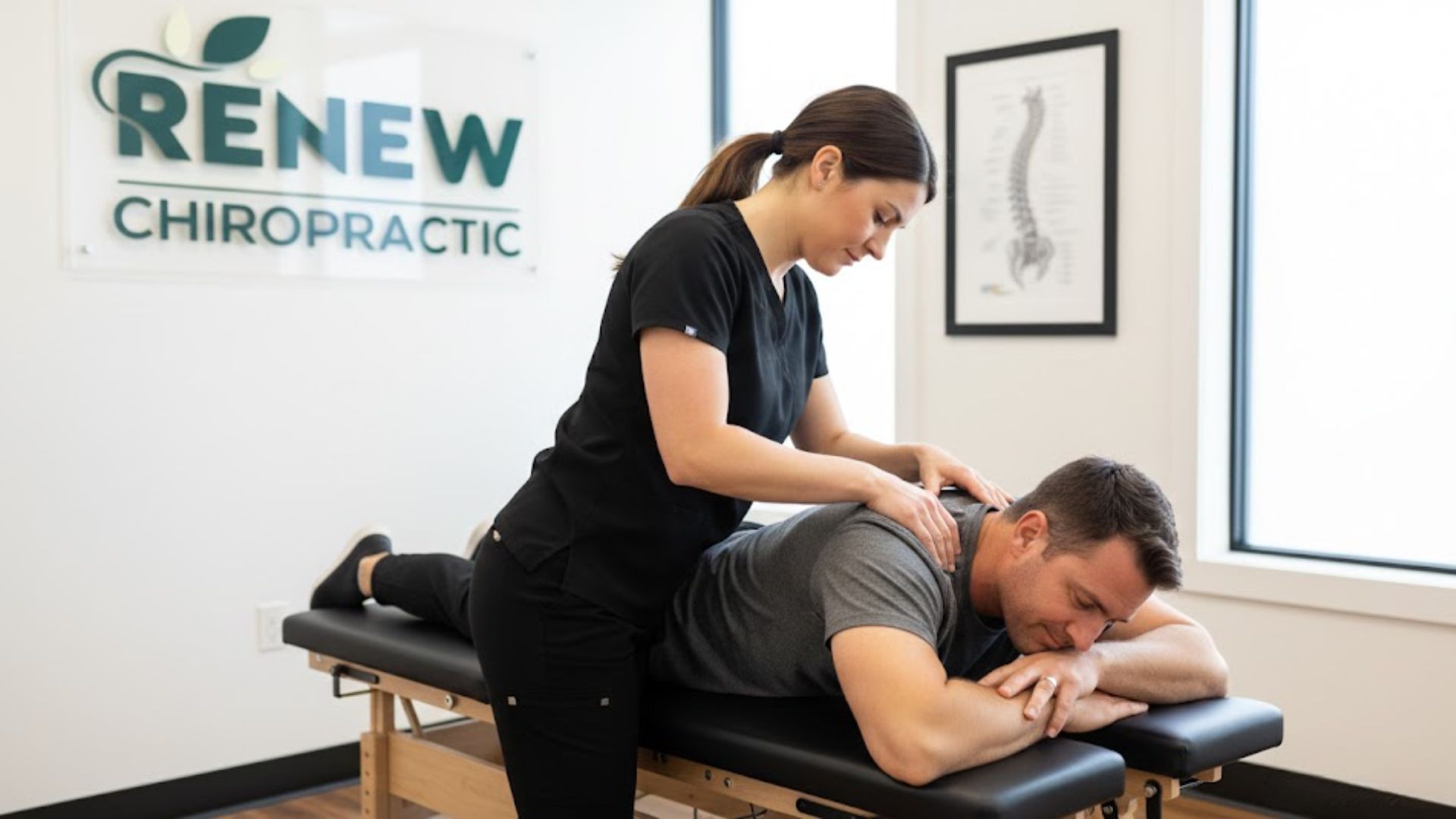

One of the questions I hear fairly often from new patients is: “Are you going to crack my back?” It’s an understandable question. Many people picture chiropractic care as one specific type of adjustment — usually a manual adjustment followed by a noticeable “pop.” While manual adjustments are one option, they’re far from the only way chiropractic care can be provided.
At Renew Chiropractic in Kirkland, I’m trained in more than 15 adjusting techniques. Some are performed entirely by hand, while others use a specialized instrument or features built into the adjusting table. Having different options matters because no two patients are exactly alike.
Some people respond very well to traditional manual adjustments. Others prefer a gentler approach. A patient who arrives with significant discomfort may need something different from an athlete working on mobility or someone coming in for ongoing care. My goal isn’t to fit every patient into one technique. It’s to determine which approach makes the most sense for the person in front of me.
Here are some of the adjusting tools and techniques you may see in our Kirkland office — and why I might choose one over another.
The Arthrostim: Gentle, Specific Instrument Adjusting
The Arthrostim is probably the adjusting tool patients are most curious about. It’s a corded version of an Activator — it looks like a massage tool, but it’s a finely tuned adjusting instrument that oscillates at a very specific speed.
It’s a handheld instrument that delivers quick, controlled impulses to a specific area. It allows me to make an adjustment without using the larger movements that are sometimes associated with traditional manual chiropractic care, and to address the muscles and tendons in a gentle way. Most patients describe the sensation as a gentle thumping.
I often use instrument adjusting when someone prefers a lower-force approach or isn’t comfortable with traditional manual adjustments. It can also be useful when I want to work very specifically with a particular area.
For patients who are hesitant about chiropractic care because they don’t want their neck or back “cracked,” it’s important to know there are other options — and they can even work better than the traditional techniques. A chiropractic adjustment doesn’t have to look the same for everyone.
The Adjusting Table Is a Tool, Too
The chiropractic table may look fairly simple, but certain tables are designed to assist with the adjustment itself. With a drop-table technique, a section of the table lifts slightly and then moves a short, controlled distance as pressure is applied.
Patients occasionally notice the sound of the table before they notice the movement. That’s completely normal — the table is designed to move that way.
Using gravity to our advantage, plus the table’s movement, allows me to approach an adjustment differently and can reduce the amount of movement required from the patient. I may use this type of technique when working with areas such as the pelvis or lower back. For some patients, it can also be a comfortable alternative to a more traditional manual adjustment.
Manual Adjustments Still Have an Important Role
Even with all of the tools available in chiropractic care, the most useful tools are still my hands. Manual evaluation gives me direct feedback about how an area is moving. Before making an adjustment, I’m assessing joint motion, comparing areas, and looking for differences in how the body is moving.
If a manual adjustment is appropriate, I can then apply a specific movement to that area. Sometimes there is an audible pop. Sometimes there isn’t. The sound isn’t what determines whether an adjustment was effective — it’s just pressure changing in the joint fluid.
I’m much more interested in what changes afterward. Can you turn your head more comfortably? Does bending feel different? Has a movement that was restricted become easier? Those changes are much more useful to me than how much sound an adjustment makes.
Having More Techniques Doesn’t Mean Using More Techniques
Being trained in multiple adjusting methods doesn’t mean I try to use as many as possible during an appointment. Sometimes one specific adjustment type is all that’s needed.
Other times, I may use an adjusting instrument in one area and a manual technique in another. The approach can also change from visit to visit depending on how you’re moving and responding to care.
The important part isn’t how many techniques we use. It’s choosing an approach that makes sense for that particular patient at that particular point in their care. That’s one of the reasons I’ve trained in more than 15 chiropractic adjusting techniques. Having more options allows me to adapt care rather than expecting every person to respond to the same method.
What If I Don’t Want My Neck Manually Adjusted?
Tell me. Patient comfort is the most important part of care.
If you’ve been to a chiropractor before and know there is a technique you prefer, that’s helpful information. If you’ve had an experience you didn’t like, I want to know that as well. And if you’ve never had an adjustment and you’re simply nervous about it, we can discuss that before treatment begins.
You should understand what we’re doing and feel comfortable asking questions about it. There is often more than one way to approach the same area, which is exactly why having different adjusting techniques available can be valuable.
How Do I Decide Which Technique to Use?
The tool doesn’t come first. The assessment does.
Before deciding how I want to approach an area, I want to understand why you’re there and how your body is moving. That may include looking at your range of motion, checking joint mobility, comparing one side to the other, or asking you to repeat a movement that causes discomfort.
Sometimes I’ll have a patient perform the same movement several times. There’s a reason for that. I’m looking to see whether the movement changes, whether one direction is easier than another, and whether working with one area changes what you’re experiencing somewhere else.
Those details help guide the treatment approach. And the technique I choose may change over time. What makes sense when you’re experiencing significant discomfort on your first visit may be different from what makes sense several weeks later when you’re moving more comfortably.
So, Which Chiropractic Adjustment Is Best?
There isn’t one technique that’s best for everyone.
- The Arthrostim may be an excellent option when I want a quick, specific, lower-force adjustment
- A drop-table technique may be more appropriate in another situation, such as working with the pelvis or lower back
- A traditional manual adjustment may be exactly what another patient responds to best
That’s why I value having different tools and techniques available. Not because every patient needs more treatment, but because every patient shouldn’t automatically receive the same treatment.
If you’re looking for a chiropractor in Kirkland and have questions about what an adjustment will feel like — or you’re hesitant because of a previous experience — you’re always welcome to ask. At Renew Chiropractic, we’ll talk about your concerns, assess what’s going on, and choose an approach that makes sense for you.
The technique should fit the patient, not the other way around.
Nervous About Your First Adjustment?
Tell us what’s on your mind. We’ll talk through your concerns, assess what’s going on, and choose an approach that feels right for you.
Book an Appointment